Thomas Ord 1779-1859
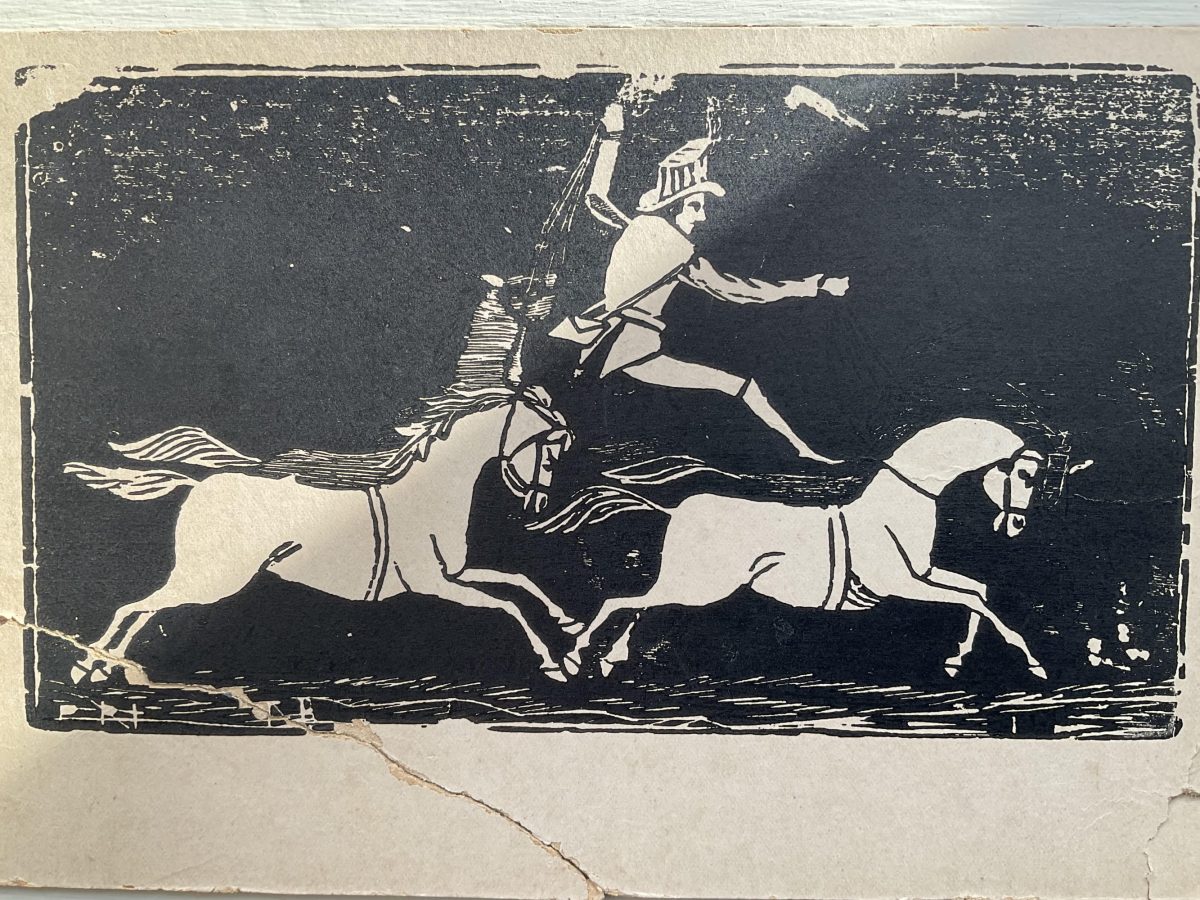
Thomas Ord 1779-1859
Thomas Ord, equestrian, circus proprietor, entrepreneur, Biggar homeowner and, at the last buried, alongside his second wife Clara Jane, in the churchyard of Biggar
Kirk. As far as we know he was born to the wife of a church pastor in 1779 in Berwickshire, ran away from home rather than study medicine, and joined a cavalry regiment from which he was cashiered out by an uncle. It is reported that a variety of farm employments were followed by an intensive equestrian apprenticeship (Fleming, pg. 157) and, declining the offer of permanent circus work, he set out to entertain with only a performing donkey in tow. Ord was notoriously reticent about his past life, but by piecing together available reports, it is clear that he was a restless young man, determined that a conventional life was not for him and in effect he did ‘run away to the circus’ not only to perform, but also to become a star equestrian and famous circus proprietor.
According to his grand daughter, Jane Shand, after finishing his apprenticeship he purchased a horse, and engaged a few other artistes. “He was a host in himself. Besides being a rider, he was a good tumbler and somersault thrower, and about as good a dancer as could be imagined. He was an actor, too, of no mean order. He had a fine voice, and could play the violin most acceptably.”.(Shand, pg.15) His circus joined the circuit of the other troupes of the time and he travelled widely, using horse and wagon, to small towns and villages in Scotland and the north of England. Thomas Ord soon became a by-word for circus in the North and a much respected and admired man.
It is difficult now to imagine the excitement and importance of the visiting circus. To a poor and rural populace these fantastic and magical spectacles would have provided an experience for which people would travel many miles, relishing a chance to dress up, mingle and let their imaginations play. No doubt the local inn did a roaring trade. A ring was dug on a patch of land near the town and the turfs provided a surrounding seating area for the audience. These were known as Ord Rings and were intended to remain in place until the next circus visit. The show was in the open air and attendance was free with all profits being made through the sale of lottery tickets, which featured prizes as varied as a sheep to a bolt of cloth. There would be fireworks and no doubt burning torches to light the scene. The performers dressed in colourful costumes with frequent changes in keeping with the acts. Jugglers, acrobats, dogs jumping through burning hoops and, of course, horses on which the rider would perform acrobatic feats or act out stories based on famous, or sometimes local, characters. Audience members with special skills might be urged to contribute and perhaps a particularly skilful one might travel with the circus to the next venue. The festive atmosphere would be supplemented by local and travelling hawkers and no doubt many a saved up coin would be spent. At this time exotic animals were not part of circus acts though there are reports of single bears or an elephant, and even a zebra, being displayed alongside a travelling circus. No doubt children would be much in evidence trying to re-enact performances. All in all a noisy, chaotic, colourful and, a likely, very muddy scene.

The city based circus industry was already well developed. In London Philip Astley, oft considered the father of modern circus, had built his Royal Amphitheatre and we can see from the illustration above [figure 2] how sophisticated British circus provision had become. By taking the circus to small towns and villages, especially throughout rural Scotland, Ord was contributing an important offshoot to a rapidly expanding industry. The large establishments were much grander in terms of numbers and equipment, but many of the acts were similar to those of their smaller cousins, and identical acts appear regularly across advertising posters of many circuses. In general these acts related to daring deeds from history or the contemporary news; tableaux depicting well known battles and scenes from history and Empire; skilful juggling and acrobatics and, at their heart, the contemporary circus equestrians. Ord was widely considered to have skills equal to such contemporary circus stars as Thomas Cooke, Philip Astley or Andrew Ducrow and there is an oft quoted story of him challenging ‘anyone’, for the sum of five hundred guineas, to out-perform himself. Such was his prowess that he frequently lent his skills to other circuses.
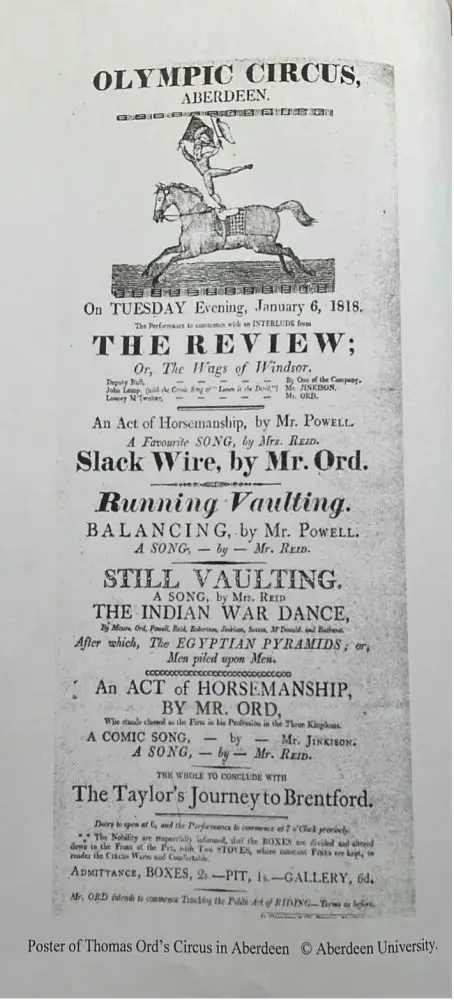
During these early years Ord’s circus grew in size as the number of acts, artistes and horses increased. For open air performances he frequently constructed large temporary wooden seating areas which were capable of accommodating upwards of a thousand people. He was making money, and despite having lost a large amount in a bank collapse “By the end of 1817 had again put together an impressive circus with a number of artistes”. (MacMillan pg. 15).The Aberdeen advertising poster reproduced here [figure 3] shows how far he had progressed as he is now charging two shillings for a seat in a heated box and is offering riding lessons. In rural areas his stays were for a few days, whilst in towns the performances could stretch to several weeks or even months. For example he appears to have stayed in the thriving port of Aberdeen for at least nine months. To Ord, the shrewd businessman, the combination of large and enthusiastic audiences and, a sound base for dispersing small troupes to Highland areas, would have proved attractive. There followed various travels including to Dublin, Edinburgh then back again to Aberdeen.
By 1831 he had amassed enough finance to build an amphitheatre in Glasgow. It promptly burned down but three years later, following visits to Dumfries, Preston and Edinburgh, he was able to build a second Glasgow Ord’s Amphitheatre for his twenty eight horses and fifty performers. This is described by McMillan as probably the peak size.(McMillan, pg 36). A fine amphitheatre and a large troupe of artistes, but in a very short time he was taking his circus back to Dublin. Why? Ambition? Personal reasons? Perhaps he relished being on the move and reaching new audiences. As his short stay in Glasgow had brought him a profit of a thousand pounds, he was financially cushioned for a while. Next saw a few months in Dundee, where he built another large amphitheatre to house twenty five horses and forty eight performers and thence to Whitehaven in England for four months, where he again built his own amphitheatre. As with all travelling circuses of the time these constructions were intended to be semi-permanent and were built of wood and canvas with heating provided by stoves. His stay in Whitehaven was followed with renting a suitable theatre in Liverpool and thence to a four year financially disastrous foray into Wales, with vague reports of him being defrauded.
Biggar
Following this last foray his Biggar connection begins. In 1841 he returned to Scotland with only three horses, but by 1843 he was able to purchase a house in Biggar and, encouraged by an enthusiastic local reception, construct a small wooden amphitheatre. Unfortunately local interest waned and the circus building survived only a few months before being demolished. This house [figure 4] was to remain in Ord’s family for many years but was eventually demolished in the twentieth century.

Whilst keeping the Biggar house as a base, and with a much smaller troupe, he again travelled throughout Scotland, presumably making more use of a rapidly expanding Scottish rail network. In 1845 he built a small amphitheatre in Wick where, as a sideline, he again gave riding lessons. In 1847 there followed the construction of his last circus building in Inverness. From that time forward Ord’s career went full circle as he constrained himself to small travelling performances throughout Scotland and resumed charging by lottery ticket purchase. Despite his advancing years he continued to provide such equestrian skills as he could manage until ill health drove him back to his home in Biggar where he died in 1859.He was entombed alongside his second wife, Clara Jane in Biggar Kirk churchyard. The memorial [figure 5] that can now be seen over his tomb was erected by his daughter Selina in 1875.

Performances
Unfortunately little information exists about specific performances, but we can assume that it varied from site to site depending on performer availability. When the circus was based in a town for a few weeks or more, the programme would be regularly changed to ensure repeat visits from audience members. Performers would have included clowns, jugglers, acrobats, trick dogs, and performing horses. Ord’s wives and children would likely have performed in the ring as acrobats, clowns or by assisting with his acts. Taken from a poster advertising a Whitehaven performance is the following “ … Mr Ord will ride, drive and manage eight horses, and while managing six of the above, will carry three children. Travelling circuses were family affairs, small worlds in which children developed skills which frequently translated into becoming adult performers. Through Thomas Ord’s daughter Selina we see the marriage partnership that gave birth to Ord Pinder’s Circus which was to become the famous Pinder’s Circus that still exists today.
More detail of acts from later in his career can be seen in the remaining advertising posters of the time. Most of these posters speak for themselves, as performances were described in some detail. Ord’s horsemanship would largely be demonstrated through leaps, jumps and acrobatics whilst riding bareback at speed or standing on the back of horses. He is known to have handled at least six horses at one time. In line with other skilled circus horsemen of the time, he would enact short stories of an heroic or comic nature. Usually these involved well known fictional characters of the time. The following provide brief descriptions of a few of these.
On January 6th , in Aberdeen [figure 3 above] we see The Taylor’s [Tailor’s] Journey to Brentford, an act created by Philip Astley in 1768. The failure of a tailor (Billy Buttons) to reach Brentford in time to vote involved much skilled falling from horses and general clowning.
From an 1834 Edinburgh poster we see ‘Mr Ord’s Unrivalled Scene of Paul Pry on Horseback’. Paul Pry was a well know character from a comic play. His bumbling and nosiness must have transferred well to horseback antics, and he again appears in a 1836 poster from Whitehaven, in which “Mr Ord’s laughable act of Paul Pry; or, I hope I don’t intrude …” introduces “four different characters without quitting the saddle …”
His Whitehaven circus was particularly productive with equestrian acts as varied as ‘Bailie Nicol Jarvie’ from the novel, Rob Roy and ‘Tam O’Shanter’ from the Burns poem, no doubt depicting a very drunk Tam and a clever horse. And bearing in mind clever horses, it was in Whitehaven that Ord introduced his ‘matchless pony, Butterfly’ ‘The Drunken Hussar’; ‘Carnival of Venice … personifying six favourite characters’;‘Flight of the Wild Horse’ – the list goes on.
Making a regular appearance was ‘Courier of St. Petersburgh’, an act devised by Andrew Ducrow that involved the rider straddling two cantering horses and handling the flags of countries traversed by the courier on his journey from Russia. Another regular act was ‘Mrs Ord’s Grandmother’, which was, of course, Ord dressed as Granny and supposedly carrying her grandson on her back.
A far fuller listing of Ord’s various appearances, his acts and even the names of his horses is provided in the Stuart McMillan book cited below.
No illustrations of Thomas Ord, or his performances, have been found and he told his family very little about his past. Through reading accounts of the time we know that he was a tall and dignified man who retained good standards of agility and eyesight into old age. Extraordinary levels of energy and discipline must have been essential when overcoming the difficulties of circus organisation whilst intermittently having to cope with financial and personal setbacks. He is known to have had three wives, of whom the first drowned, the second died of typhus and the third outlived him. He moved between states of relative poverty and affluence and was respected and admired throughout Scotland. His equestrian skills were famed, as was his skill with, and his love for, horses. Stabling for these was always found before his own lodgings were settled. He was a Freemason and regular church goer, who had strict rules about behaviour amongst his troupe, and was a philanthropist who regularly gave performance benefits for causes or individuals. What is clear from looking back at his long career, is his determination to provide circus entertainment, particularly throughout Scotland. Thomas Ord must have been a very special person.
Further Reading
- Hunter, William. Biggar and the House of Fleming: an Account of the Biggar District, Archaeological, Historical, and Biographical, Edinburgh, William Paterson, 1847.
- McMillan, Stuart. Thomas Ord: Circus Proprietor, Scotland’s Greatest Equestrian, Founding Father of Pinder’s Circus, Glasgow, The Smiddy Press, 2010.
- Shand, Jane, A Sketch of the Life of Thomas Ord, the Equestrian, Biggar, 1902.
Much of the information for this piece was taken from Stuart McMillan’s book. Thomas Ord: Circus Proprietor …, Jane Shand’s booklet A Sketch of the Life of Thomas Ord, the Equestrian (both cited above) and various newspaper reports of the time. Copies of the McMillan and Shand books can be found in the Biggar Museum Archive. An introduction and illustrations prepared for a museum exhibition are also available in the museum archive.