Support Us
Support Us

Biggar & Upper Clydesdale Museum
156 High St
Biggar, ML12 6DH

Biggar Museum Trust SCIO, a registered charity in Scotland. Charity number: SC003695

Tel: 01899 221 050 Support Us
 

John Brown M. D. Physician and Essayist Novelist (1810-1882)

John Brown, was a Scottish physician and essayist best known for his canine story, “Rab and his Friends”1859, and his essays “Pet Marjorie”, “Our Dogs”, “Minchmuir” and “The Enterkine”. His greatest achievement however was his three-volume Horea Subsecivae (Leisure Hours)1858, a collection of essays on art, medical history and biography. Brown was born in Biggar, “the canny little capital of the Upper Ward “ as he later described it. He was the son of Jane Nimmo and John Brown, a local clergyman of the Secession church. His mother died when he was six years old. He was privately educated until he was 12 years old when he moved to Edinburgh to attend it’s High School and later University.
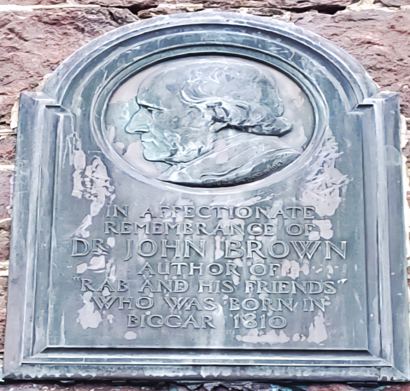
Commemorative Plaque at Municipal Hall

After graduating, Brown practised as a physician in the city and subsequently acquired a large medical practice at a time when infectious diseases were rife. In 1840 he married Catherine Scott and their marriage produced three children. In 1847, Brown became a Fellow of the Royal College of Physicians of Edinburgh and for a while was Honorary Librarian. He began writing in response to a request for contributions to the notices of paintings exhibited by the Royal Scottish Academy. The editor of the Scots-man newspaper then asked him to write regularly for the paper. He was 48 years old when he published Rab and His Friends. The book was a popular success. He had told the story of Rab to friends many times but had never written it down until he was asked to give a talk in Biggar by his uncle. He decided to write the story out and read it to the audience. It was from this script that the book emerged. Brown was awarded a royal pension in 1876 ‘for distinguished literary eminence’. Sadly Brown suffered during the latter years of his life from depression. He died at home at 23 Rutland Street in Edinburgh from pleurisy on 11 May 1882, and was buried in his father’s plot in New Calton Burial Ground.

Author: Bill Deerin
Date: 23rd Oct 2026 Back to Blog

This website uses cookies
This site uses cookies to enhance your browsing experience. We use necessary cookies to make sure that our website works. We’d also like to set analytics cookies that help us make improvements by measuring how you use the site. By clicking “Allow All”, you agree to the storing of cookies on your device to enhance site navigation, analyse site usage, and assist in our marketing efforts.
These cookies are required for basic functionalities such as accessing secure areas of the website, remembering previous actions and facilitating the proper display of the website. Necessary cookies are often exempt from requiring user consent as they do not collect personal data and are crucial for the website to perform its core functions.
A “preferences” cookie is used to remember user preferences and settings on a website. These cookies enhance the user experience by allowing the website to remember choices such as language preferences, font size, layout customization, and other similar settings. Preference cookies are not strictly necessary for the basic functioning of the website but contribute to a more personalised and convenient browsing experience for users.
A “statistics” cookie typically refers to cookies that are used to collect anonymous data about how visitors interact with a website. These cookies help website owners understand how users navigate their site, which pages are most frequently visited, how long users spend on each page, and similar metrics. The data collected by statistics cookies is aggregated and anonymized, meaning it does not contain personally identifiable information (PII).
Marketing cookies are used to track user behaviour across websites, allowing advertisers to deliver targeted advertisements based on the user’s interests and preferences. These cookies collect data such as browsing history and interactions with ads to create user profiles. While essential for effective online advertising, obtaining user consent is crucial to comply with privacy regulations.