Elizabeth Buchanan Mitchell 1880-1980

Tucked away on the wall of a narrow road by the side of Biggar bookshop, Atkinson-Pryce, is a Heritage Environment Scotland commemorative plaque to Elizabeth Buchanan Mitchell. Much to her delight this opening to a small cluster of houses, had been named Mitchell Knowe, by the then Parish Council, in honour of her various contributions to Scottish town Planning and to Biggar, the town she loved and where she lived for over thirty years.

By all accounts she was an un-assuming, though formidable and industrious woman: one of the first Scottish women to study at Oxford University; author of a published book on pre-World War One Canadian communities; member of agricultural and educational committees; a Liberal candidate for Parliament – the list goes on. Perhaps most notable of all was her ongoing commitment to town planning and its importance to peoples’ quality of life. An early advocate of New Town and Garden City theory she was a lifelong member of the Town and Country Planning Association (TCPA), which was to award her the prestigious Ebenezer Howard medal. Her input was central to maintaining the influence of the TCPA in Scotland and in recognition she was appointed in 1953 to membership of the East Kilbride Development Corporation.


For over thirty years Elizabeth Mitchell lived with two of her sisters in Langlees, a house on the outskirts of Biggar and between 1935-53 was a member of Biggar Town Council, serving from 1947 as Convenor of the Housing Committee. It seems certain that the influence of her ideas can be seen in the small Knocklea social housing development in Biggar, with its open layout, wide green spaces and countryside backdrop. Tucked away in the Lindsaylands Road corner of Knocklea is a small area of land that she released from the Langlees Estate and had planted with trees. This is Little Mitchell Wood: an area much used by local children as well as being a pleasant starting point for country walks. This area continues to be maintained by volunteers of Biggar and District Community Heritage. In addition to Knocklea, her influence extended to an area of the High Street just along from Cadger’s Brig where she restored an old house and made one floor available to a Polish woman who provided daily help at Langlees and the other to a local tradesman. On her death she left the property to the tenants. Behind the house is a triangle of land that she bought and gave to the council for housing, stipulating to Biggar Council that it should be used for providing accommodation for single women or widows. This is Mitchell Knowe, as mentioned above, where the Scottish Environment Heritage plaque has been placed in her honour.
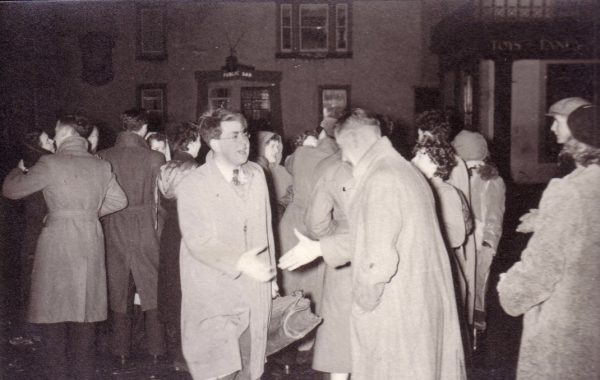
Her consistent behind the scenes work included the planning of the 1951 quincentenary celebrations of Biggar being granted a Burgh of Barony: a grand occasion that saw the first Biggar riding of the bounds. An event that is now enthusiastically re-enacted as the Riding of the Marches at the start of the annual Biggar Gala Week. Elizabeth Mitchell, Brian Lambie and Gilbert Rae did an exploratory walk to trace the bounds and it was while on this walk that the photograph at the head of this blog was taken.

There can be no doubt that her unrelenting active service to improving social conditions was largely driven by her deep religious convictions and she did much behind the scenes work with both the Moat Park and Gillespie Church.
A more detailed description of Elizabeth Mitchell’s life that accompanied a small exhibition, can be seen on request in the Biggar Museum, as can her book ‘The Plan That Pleased’ and Jean Lindsay’s book ‘ Elizabeth B. Mitchell: the Happy Town Planner’.