Brian Lambie’s Memories of the Polish Forces in Biggar
MEMORIES OF THE POLISH FORCES IN BIGGAR DURING WORLD WAR II
The song, “You are my heart’s delight” sung by Richard Tauber brings back memories of over sixty years ago, in Biggar, when he came to the Corn Exchange to sing to the Polish troops that were stationed in the district. His wife, Diana Napier, was in charge of a little hospital in the house at Symington called Easybemount next door to the Tinto Garage. It was for Officers. It was a strange place. I was only ten years old at the time but I was aware that there were things going on there possibly that maybe should not be going on. The officers were stationed in Eastend House at Carmichael, where there is still a big granite plaque up in the inside of the turret with the Polish eagle commemorating the use of the house.
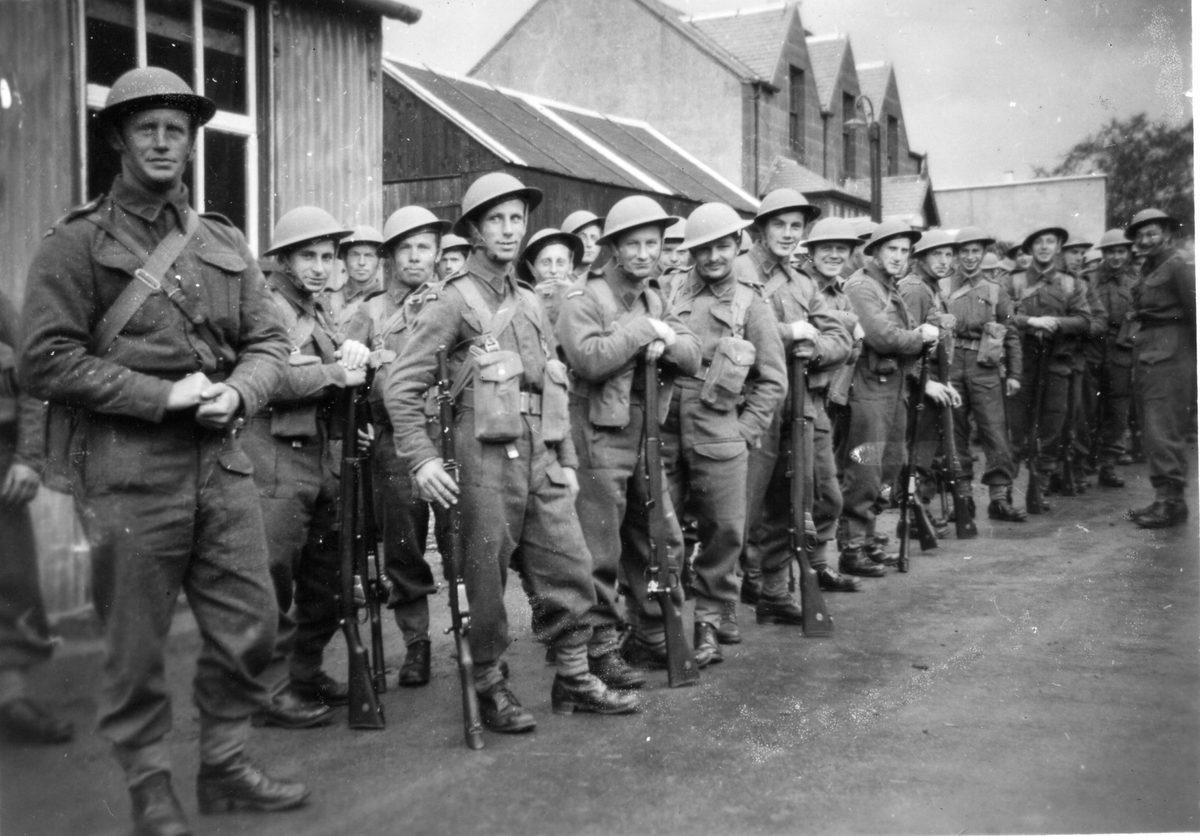
The Polish army arrived in Biggar and district just shortly after Dunkirk. Camps were set up in Coulter and Symington, over at Netherton across from Wolfclyde, and Crawford. The biggest camp I knew was the one at Wolfclyde itself.
A Church of Scotland canteen was set up in St Mary’s Hall and run, presumably, by the ladies of the Woman’s Guild and other people. We were all asked for games that people could play. So there were the usual table tennis and dartboards and things that were sent down to help while away the hours when soldiers were off duty. Most people looked in there and spoke as well as they were able to the soldiers. Quite a number of them just had the clothes they stood up in and were taken to various homes and given bathroom facilities and cups of tea. Lots of long friendships were established at that time. Two of the soldiers appeared at our gate on a blistering hot June day, and obviously looking for tea or something to drink, and they were asked in. At that time we stayed down the Mid Road.
Afterwards they came back with two friends, one in fact was not a Pole – he was Belgian and his father worked in the diamond industry and he was a fluent English speaker. His name was Pinek Pellermuter. I can remember at the dining room table being shown a clasp knife that he said he had killed several Germans with. The other three were all Polish. Vacek Chwalba, Stefan Wengorek and a wee chap called Anje – I don’t remember his last name. Stefan and Vacek were long standing friends and when they went back eventually to Poland they had a little money which they left with my father who was the local ironmonger. I think it was either £100 each or £100 between them and they said they would send for things as they needed them and this what happened during the difficult years when Poland was under Russian domination. They sent for things like M & B tablets, wireless valves, etc. which were sent out quite regularly and my father kept a little note of expenses and later on when my brother went out to Poland round about 1960 he took the remaining money back, their change in fact, in American dollars, and went and saw Anje and Ratzig. But that was very much in the future then.
The soldiers were all very nice laddies, just boys really. Lots and lots of the soldiers were adopted by various families in Biggar. We had some officers billeted with us because not all officers could be accommodated in Eastend House. Our evacuees from Townhead had gone back home after the initial war scare of 1939. We had three officers billeted with us in succession. The first one was a young man. I forget his first name. He was slim and had a pencil moustache and washed his hair in Eau-de-Cologne. He wore a hairnet at night – most of them did – and we all thought this was very strange. He stood up and clicked his heels every time mother came into the room. He had no English to start with but we had a children’s encyclopaedia with pictures of fairly normal family events – “like we go to the seaside” – in French and then it would say what the English was. So he sat down every night and learned storybook English from these French lessons in the encyclopaedia.
It wasn’t long until there were dozens of English/Polish dictionaries in Biggar. There must have been a re-print or else there had been a big stock of them. There was a large one that just about every household had – the size of the Oxford Dictionary – and it was very useful when you really got stuck. There were much smaller ones, of course, to fit the pocket – travelling ones – and we were all able to say “Dzien dobry” and “ para bota” a pair of boots and “pomedore” tomatoes and all the Polish names for things began to be used and many people were sort of bi-lingual. There were also other books that the Poles scoured the bookshops in Edinburgh for, probably things that nowadays would be remaindered but, at that time, were still on the shelves in the good quality bookshops. Books like Murray McLarens “Wayfarer in Poland” which had been published probably three of four years earlier. There are many inscribed copies still in households in Biggar given as gifts by soldiers who had been befriended.
The second officer we had, was a Major Malinski, who was a different kettle of fish, he was old! He couldn’t have been much more than forty but to me that was old! (I was ten years old at the time!) He smoked strong tobacco in large tall tins that I had never seen before – you know, much bigger than the kind people bought over the counter here. He wasn’t with us very long and kept himself to himself.
The third was ……I have forgotten his name…. We had a captain, a major and lieutenant. The first one I was talking about was Lieutenant Kowaleski, then Major Malinski and then there was Captain whose name I cannot bring to mind. He was a rather chubby little man, round-faced, and round tummied. Quite often he had business to do in London. He would say to my mother “I go to London tomorrow tomorrow” and she knew then that she wouldn’t have him for a couple of days. When he came back he would generally have been to Bond Street; sweets were still off ration and he would bring back some quite large boxes of chocolates. The shop is still there – the boxes were the large flashy ones that Bond Street was famous for and mother kept knitting needles and patterns in them for years until they fell apart. Of course the trains were on the go then so it was quite easy to get from Biggar to Symington to get the main line train to London. Apart from these men there were younger ones who visited us more as friends. Many other households had similar set-ups.
We also had Poles in the shop, my father’s ironmongery shop, making things generally for the officers. The back yard at the shop would be commandeered and they would make bedsprings out of wire netting from the shop with angle iron from the blacksmith to make beds for the officers, presumably out at Eastend. One man worked up at Stephen’s Garage making the letter ‘F’ for an officer’s typewriter that must have broken off. He said “I maken ‘F’” which was part German in a way, but some of them were possibly, they had German sounding names. They were from the part of Poland that had once been part of Germany. This one in particular who made the letter ‘F’ worked about the shop quite a bit. He had been in the First World War and one day he was outside and he met Gib Elliot, the carter.
There were two Gib Elliots in Biggar, Gib Elliot, the plumber, who was younger than Gibb Elliot, the carter, who was his cousin. He delivered goods in the area with his horse and cart. He didn’t do the station lorry but he was the sort of local carrier and I think he also delivered coal for Minto, the coalman. Gib was on the High Street one day, leading his horse when he met this man. They looked at one another and realised they had been in a prison camp together during the First World War! That night someone had to take Gib’s horse home because Gib and this guy couldn’t have seen their finger oot in front of them! They had been out celebrating! This poor soldier had a son in the submarine service who was lost at sea. This was very sad for him. He gave us a canary in a wooden cage that we had for many years. It was a crabbit wee thing! He went back to Poland, I think, but being in the First World War he was very much older than most of soldiers.
Let me see….. yes, the same man went to Glasgow to one of the firms my father dealt with who had a foundry and he made a bronze pennant staff for the flag which the City of Glasgow presented to the newly formed Polish brigade. There was a ceremony out at Wolfclyde in the field before the railway bridge, which is no longer there – the Symington side of the railway bridge. The President of Poland was there and General Sikorski and General Paszkiewicz, who was in charge of the Polish troops in Biggar when they were re-formed into the 1st Polish Brigade. Patrick Dollan, the Lord Provost of Glasgow, and his wife also came and Archbishop Gawlina the Polish Archbishop as well as the Archbishop from Glasgow and the flag was blessed and there was a general jollification. The biggest event shortly before that had been when General Sikorski came and reviewed the 1st Polish Brigade and the troops marched down the High Street very much like German troops goose-stepping. They had the City of Glasgow Pipe Band with them and their own band that was, I think, stationed at Symington, but they used to march to Biggar along the road playing all the way. One of the camps at Symington was behind the strip of wood between Symington Mill and the Manse Woods in tents there and on the raised embankment under the trees they had a Polish Eagle made of whitewashed gravel and red gravel because the Polish colours are red and white.
Polish eagles appeared on just about every household in Biggar. Some of them were cast from solder, some of them were carved out of aluminium. We had a very nice one done with the Polish Motto round about it. It is now in the Moat Park Museum in Biggar along with some of the others. Often they were decorated with tartan ribbon. There was a very, very large one which used to hang in the Christian Institute, made of bully beef tins which has long since disintegrated. These were all made by skilled men who could turn their hand to anything.
Again, another thing which is in the Museum, is a piece of Laburnum wood the size of a cigarette packet which one of our Poles polished up and drilled holes in, made springs out of piano wire and then made a slot along one edge and filled it up with cigarettes and then they had a very fine looking cigarette case which was very impractical. Father, who smoked forty a day, would have needed to fill it up four times! If you weren’t very careful, you sometimes got the end of the cigarette caught in the lid but it was a very beautiful piece of wood and just showed you how they could turn their hands to anything.
When the army arrived they were in all kinds of uniforms, possibly some Hungarian ones amongst them. The British uniforms were not terribly well received because they probably weren’t as well cut as the European ones had been but they were adapted. They had no cap badges so they made their own with the Polish eagles on them until the time came when they got their official issue. These were made by a man – I think his name was Hebda. He used to go to Weir the plumber and all he could say was “five sticks”, that was five sticks of solder. He made the badges there and then in the plumber’s workshop and he became known as “Five Sticks”. Various things like that were all skilfully made.
The great thing about the arrival of the Poles was that they took over the school as offices – the Primary School. This was the nice wee Primary School we had with sliding doors opening on to a green in the centre – all very modern when I went there in 1935. It had just been opened a year or two and we found that for quite some time until things were re-organised we were only getting half a day’s tuition at school. We shared with the High School – one school had the morning and the other school the afternoon until accommodation was arranged in other places throughout the town. That was one good thing that happened when the Poles came and as soon as they were in the school they were making Vodka out of potatoes! I don’t know what it tasted like but again they were very clever in doing so many things.
The Corn Exchange was full every night. Normally there were cinema shows on a Monday, Thursday, Friday and two shows on a Saturday but when the Polish army arrived all the ancient films were dug out from the distributors in Glasgow or Edinburgh and sent down to Biggar to entertain the soldiers and the cinema was open every night! We saw some great films that hadn’t been seen for years – mainly things with people like Laurel and Hardy. Occasionally there was a concert. A very celebrated Polish pianist, Marian Zigmund, came, (I think that I was at that concert) and there was the Polish Army choir. We could all sing the Polish National Anthem. We hadn’t a clue what it meant but it was always sung very lustily. Then the great day came when Richard Tauber (we mentioned him at the beginning) came to entertain the troops in Biggar. John Gardiner was the hall keeper at the time (that is Helen Russell’s father) and he told me he had to string piano wires the length of the hall on Tauber’s insistence, to carry his voice to the back of the hall. He had a pianist to accompany him and the music was mainly Viennese light opera.
Another great day was the forming of the 1st Polish Brigade, which I have mentioned already. There was also an open-air concert at Cornhill House, which at that time was still a private house. Polish soldiers did national dancing and were aided and abetted by local girls! Quite a number of them, Jean Pollock, who was Jean Brown then, Molly Brownlie – they were both Fleming Queens in their day – and I think Jean Dempster, the Chemist and May Gibson who at 90 or 91 is still with us, Mrs Robertson, the vet’s wife, Anne Weir, and others. There was also a comedian who told his jokes in Polish but we all laughed anyway even if we didn’t understand! It was a great time for young people – the War was a terrible thing but one thing that it taught us was that there was more than just us in the world!
Later on, when the Poles departed, the prison camp at Thankerton was built. It was used first for Italian prisoners and then German prisoners and then the displaced persons after the war, when people came from places like Lithuania some of whom stayed on, and quite a number of them married locally.
Some of the Polish soldiers stayed and lived in the district. A lot went back, including General Paszkiewicz but he never really attained any prominence in Poland – his politics were the wrong colour. One of the publicity men was a man called Roman Piotrowski who was involved with the Polish Army and when he went back he became a Minister in the Polish Government but he was very quickly demoted, I think. While in Biggar he lived in the house called Lauderdale, the first of the semi-detached bungalows in Mid Road. He lived there with Miss Roberts and Mrs Lawson who stayed with her. There was a Lieutenant Lenski who was later on to become the father of the actress Rula Lenska. He is in some of the photographs of the field Mass at the Golf Course. This was after the big day when the Brigade was formed.
General Sikorski was present at a Mass held on the Golf Course. The houses of Southcroft Road can be seen in the background of the photo. A tent was put up – it was a half tent really, erected to protect the representation of the Madonna of Czestochhowa painted by one of the soldiers – in a sort of Medieval, Byzantine style The Mass was attended by the local Town Councillors and various others – probably the first Mass said in Biggar since the Reformation in 1560. The whole company of Poles were there and, at the end of the service, a painting was presented to the Biggar Town Council of a Polish sharpshooter, also one of General Paszciewicz who was in charge of the troops. Both these paintings are now in the Museum.They were painted by a man called ‘W Mars’ who later went to New York and became a commercial artist there. I once asked Felix Topolski about him. Felix Topolski came to Biggar as a war artist. I once went to see him in his hideout under the railway arches next to the Festival Hall in Edinburgh and asked if he could remember anything about Biggar. He remembered Scotland in general – he was quite an old man by then – and showed me great stacks of paper which nearly reached the ceiling and said “Oh, there’ll be something in there, somebody else will have to look through it after I am dead!” Lurking in amongst Topolski’s drawings are one or two of Biggar, which have been reproduced in books, including one of General Sikorski. Very likely taken from the photos taken of him on that big day. I don’t think terribly much of W. Mars as an artist – he was more of a representational artist than Topolski. In return the town of Biggar gave General Sikorski a shield with the Biggar Coat of Arms, also a silver salver maybe 15” across with the Biggar Coat of Arms and the Polish Eagle and an inscription.
One day Stefan and Vacek came to visit us without Pinek, the little Belgian man, who I mentioned earlier on. When I asked for him they just sort of shook their heads and said he had disappeared. I often wondered what happened to him. Then, long after the War, I spoke to a lady from Symington who is now dead. She said there had been a number of spies that infiltrated the Polish Army and, when they were found out, they just got rid of them. There were three shot by the banks of the Clyde and were just buried where they fell down near Symington Lodge and I wondered if he was one of them. His name suggests that he might have been Jewish and his father, who was a diamond merchant, may well have been the cause of it. Pinek may have been told that if he didn’t do certain things or find out certain things his family would be bound for the gas chambers. So he may have been shot.
There were a certain number of deaths, which were understandably of natural causes. There is a row of about a dozen graves, I think, war graves originally with black crosses which have now been replaced by the standard war grave stones in St John’s Kirk, Symington. It is quite nice – this almost redundant churchyard between Symington and Thankerton that was used for the Polish soldiers. I think there are some Italians and others there as well. These graves were unmarked and, in the case of the Germans, one at least committed suicide but the Polish soldiers lie in a row together. A few years ago the son of one of them came over to see where his father was buried. I think the cause of his death was a burst appendix. When he died, I think, he did not know of the birth of his son.
The first Polish children who were born in Biggar were born to Mrs Polanska who is still alive and living in Peebles. She lived in Biggar for a long long time. She had twins – two girls – both very clever girls. At this time Mr Polanski had not turned up and was missing presumed dead and Mrs Polanska married again and had another little girl. All these three girls were very clever at school. Then Mr Polanski turned up, and sadly, husband number two had to go away. After the war the family stayed and the father set up business as a shoe repairer in a semi-derelict house in the High Street and the family rented a house from Miss Mitchell of Langlees, the one with the very low door that has its gable end on to the High Street. Mrs Polanska did general housework, up at Langlees for Miss Mitchell who was very good to them. Miss Mitchell was in fact very good to all the Poles. The Poles presented Miss Mitchell with an album of photos which are now in Moat Park Museum. There were other children in the town who came from Poland. There was a wee fat boy with a fur coat who was in my class at the school but I would need about ten minutes to think on his proper name but I knew him as Anje. Other children appeared from time to time with parents who arrived at different times.
After the 1st Polish Brigade was formed the soldiers were sent from Biggar to guard the east coast of Scotland. There were lots of concrete barriers put in, machine gun posts, up the coast there right as far as the Moray Firth. They didn’t particularly want to do this – they wanted to be back in Europe. There was a big colony of them in St Andrews, and Dundee. One of our Poles, Wacek Chwalba, one of those who went to guard the east coast, had a deep friendship with a girl called Ella McManus and we went on one occasion to see him there and occasionally they visited us. But when he went to Poland he went without her because she didn’t really want to go.
Other Poles married local girls. Nancy Marshall was one, a niece of the Miss Penmans who had the sweetie shop in where Simpson’s Flower shop is now. Nancy married Vladic Lucazic. Stanley Grybski married Margaret Glaister from the Telephone Exchange and they had a little girl called Margo who is married to one of the Cursiter family and has been away from Biggar quite a long while. Stanley was left a widower quite early on in life and just died a few years ago. I think he was a lieutenant. Then there was one of the Galbraith family who married Michael Szobic and they had a little girl as well. When his wife died he went back to Poland and met up with a former friend who he brought back as his wife. She survived him by a number of years. Dorothy Shields who was in the Wrens married a chap called Chmielewski (he changed his name to Lerski) and their two boys, Richard and Sandy Lerski, went to Biggar High School. So many of them were very clever, the hybrid of Scots and Polish genes seemed to produce quite a number of people whose names appear on the dux roll and prize list at the High School.
Most of the Poles were very generous in giving children Polish coins which we thought would be very valuable but of course there was no way they could use them. They emptied their pockets and gave us sweets too. I think I have still got several zlotys and Polish and French bank notes that they brought with them. Quite a number of these are inscribed in Polish to the people they were given to as souvenirs.
They had their own newspaper. In it appeared reports of the coming of General Sikorski. Also the visit of the Duke of Kent who inspected the camp out near Thankerton and had lunch with the Polish officers in the High School, in what was then the gymnasium. The Crown Hotel was brought in for the catering and Mrs Anne Reid, who died a few years ago, was one of the waitresses at the Crown and often reminisced about the dinner that was held for the Duke of Kent who was killed not long after this.
When the Poles left for the east coast they went by train and it was said that every Polish soldier who survived Dunkirk passed through Coulter Station at one time at least in their career. The branch line from Symington to Peebles was in existence then and most of the soldiers arrived by train. They all departed from Biggar station when the time came for them to go. They were given a great send off from the station – school children, girl guides and local people were all there to see them off. They weren’t terribly happy about going to guard the Scottish coast. They would have rather returned to Europe to fight Germans but eventually they did get their chance and later on many fought in Italy and they took part in the Normandy landings.
A year or two ago, when I was still involved with the Museum, I had a visit at Moat Park from a Hungarian gentleman who had been in the Polish army. He said he arrived in Biggar with two shirts and no socks, so he cut the sleeves off the shirts and made himself socks. He said, “I was well off – some people had no shirts and no socks!” We went through the albums in the Museum and were able to pick out dignitaries and some of the ordinary soldiers that he knew. When he left he gave me his card, which said he was the Economic Adviser to Marks & Spencer so he had come a long way from having no shirt and no socks!