The Story behind the Photograph – Polish Soldiers in Biggar 1940
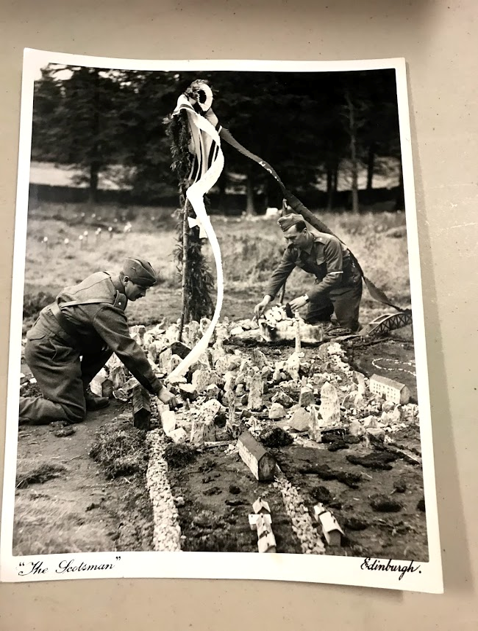
Among the archives of Biggar Museum, a discovery was made recently of an unidentified photograph showing two soldiers working on what appears to be a model of a town. It had been taken by a photographer from “The Scotsman” newspaper. The Museum of Scotland, at the request of Biggar Museum, searched The Scotsman’s archives and found the photograph in the Saturday edition of the 17th August 1940 with the caption “Polish soldiers at work on a model of the city of Warsaw which they have constructed in their Scottish camp.” An article in the previous day’s newspaper entitled “A Day with the Polish Soldiers” began to throw some light on the story behind the photograph. A further search of Biggar Museum archives provided a second article from another newspaper and a number of photographs taken on the day.
It seems that the occasion was a national holiday, the Festival of the Soldiers Day, held annually in Poland on the 15th August. The festival dates back to August 1920 when a small Polish army repulsed the invasion of a superior Russian force on the outskirts of Warsaw. The event is known as the “ Miracle of the Vistula” and it assured the survival of the Republic of Poland. It is possibly no exaggeration to say that this victory stemmed the spread of communism across Europe at that time. It is interesting to note that General Sikorski who, twenty years later became Commander-in-Chief of the Polish Army, fought in this conflict.
The festival is not only a military celebration but also a religious one, the 15th August being the day of the Assumption of the Virgin Mary. All Poland had prayed to her for victory against the Russians, apparently encouraged to do so by Pope Benedict XV. The festival has been celebrated by Polish forces since then, apart from a break between 1947 and 1992 when the communist government was in power.
In September 1939 Poland was invaded and occupied by Nazi Germany despite the valiant efforts of the Polish army. They were forced to flee their country and continued the fight in France until the retreat of the British troops from Dunkirk in May 1940. With the final fall of France, an agreement was made between Poland and Britain that the Polish army, under its Commander- in- Chief General Sikorski, should be reformed on British soil. It was agreed that their role would then be to defend the east coast of Scotland against the threat of invasion from across the North Sea. Scotland and Poland had trading and cultural connections going back at least to the 16th/17th centuries so this latest alliance was a natural extension of their ancient connections.
The first contingent of Polish soldiers came to Britain sometime in May/June 1940. They travelled by train to Glasgow after leaving France and then shortly afterwards were deployed to various parts of Lanarkshire. Stories were told of bedraggled war weary men with only the clothes they stood up in, being warmly welcomed by the local people and taken into their homes to receive food and clothing and friendship.
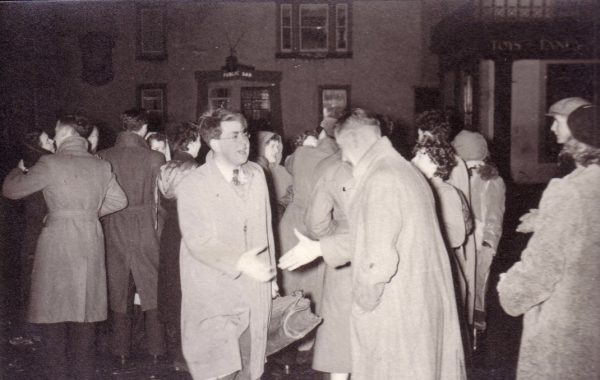
Several tented camps were set up for the soldiers around Biggar – Netherton, Symington, Cornhill, Wolfclyde and Coulter – as well as around Crawford and Douglas. The officers were billeted with families in and around Biggar. Advance defences were set up outside Biggar with barricades at each end of the High Street. The local population must have felt very well protected! Many lasting friendships were forged during the next few months, some of the soldiers returning after the war to marry local girls they had met during this period.
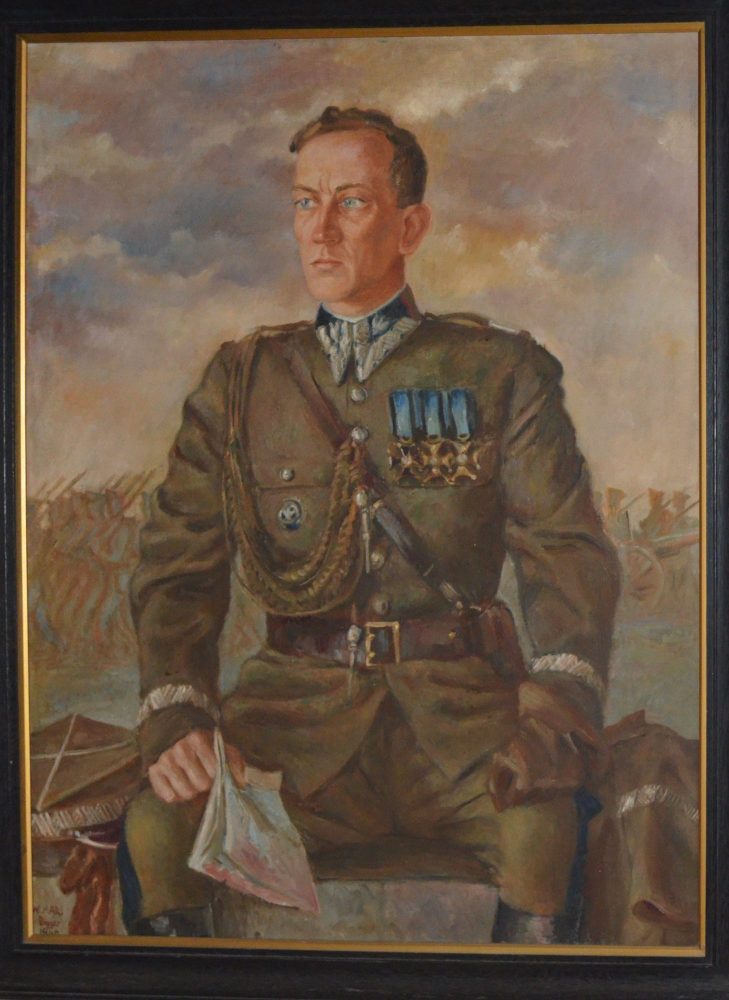
July the headquarters for all these camps was set up in East End House on the Carmichael Estate, at Thankerton. One of the main tasks was to organise the Polish troops, of about 16,500 officers and men, into a number of brigades. The first brigade to be set up at Biggar and the first in Scotland, was the 1st Rifle Brigade under the command of General Gustaw Paszkiewicz. Their regimental badge displayed an eagle and a thistle to demonstrate their allegiance with the Scottish people. Biggar Primary School building became their headquarters.
During the next two to three months the soldiers of the 1st Brigade, and other brigades billeted in Lanarkshire and elsewhere in southern Scotland underwent further military training. They were then assigned to various places along the east coast of Scotland in Fife and Angus where there was a very real threat of invasion from Nazi occupied Holland and Belgium.
So, the photograph of the two Polish soldiers turns out to be part of a special Polish event in Biggar on the 15th August 1940 celebrating the Festival of the Soldiers. From a number of articles and photographs held in the museum it has been possible to work out the programme of events on that special day of celebrations in Biggar.
The full length of the High Street was bedecked with Polish and Scottish flags and shields engraved with the Polish Eagle were displayed in every window. The whole town turned out to cheer the Polish soldiers. A number of dignitaries were present, among them General Sikorski, Lord Hamilton of Dalzell the Lord Lieutenant of Lanarkshire, Lord Provost Dollan of Glasgow and Mr Brown, Provost of Biggar. A Glasgow Pipe band was in attendance and soldiers and town folk moved to Biggar Golf Course for the first event of the day, the celebration of mass.
An altar had been set up under canvas with a copy of the Madonna and Child of Czestochhowa, painted by one of the soldiers, hanging above it. The celebration of mass carried out by the priests in their gold and purple robes and the fervent rendering of the Polish hymn “ Oh God give us back our country” by a choir of Polish soldiers, was a very moving ceremony.
Mass was followed by the second of the morning’s events, the taking of the oath of fidelity by the Polish soldiers now formed into the 1st Rifle Brigade. The oath was administered by the Polish priest, a Jewish rabbi and a Presbyterian minister. Both General Paszkiewiczk and General Sikorski addressed the soldiers, reminding them of their great victory, “ the Miracle of the Vistula” twenty years ago to the day. Now they must fight again for their country and for the rest of the world against the forces of evil alongside their British companions.
Several gifts were exchanged, the Polish brigade presenting to the town two portraits of Polish soldiers one of them being a portrait of General Paszkiewiczk. The town of Biggar, in return presented General Sikorski with a shield showing the Biggar Coat of Arms and a silver salver engraved with the Biggar Coat of Arms, the Polish Eagle and an inscription.
This ceremony was followed by a march past of the 1st Brigade led by their commander along the High Street, General Sikorski taking the salute from a dais. Once more the street was thronged with on lookers cheering and waving as the soldiers passed.
In the afternoon the townsfolk and dignitaries were invited to view displays set out in the woods by the soldiers. One display was the very model of Warsaw seen in the “Scotsman,” see photograph above. This type of modelling was commonly used by armed forces, including the Polish army, to assist in the planning of military tactics. It could be, in this case, that the Polish soldiers wished to demonstrate to their allies the destruction already inflicted on the Polish capital by the German air force at the beginning of the war. Another display the soldiers created was a replica of the outside of a Polish house complete with a front garden and a stork on the roof. Perhaps they wished to show why they must once more rise up to defend their homeland alongside their British friends and allies. As General Sikorski said in his speech to his troops that day “The rivers of tears and blood will not be shed in vain. Providence has brought us to Great Britain. In these fateful days we stand by Great Britain until victory brings a reconstruction of Europe.”
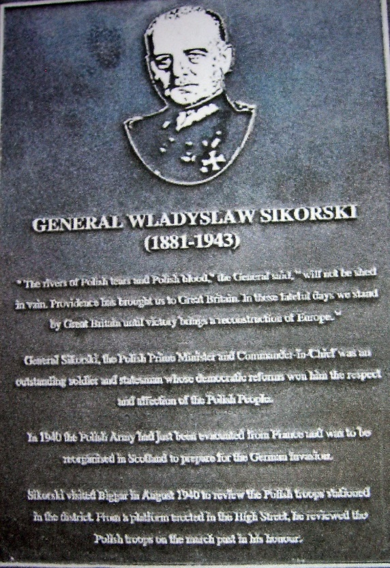
A plaque on the wall of The Elphinstone Hotel, (see above) records the visit on that day, the 15th August 1940, of General Wladyslaw Sikorski, the Commander-in-Chief of the Polish Army who came to review his troops.
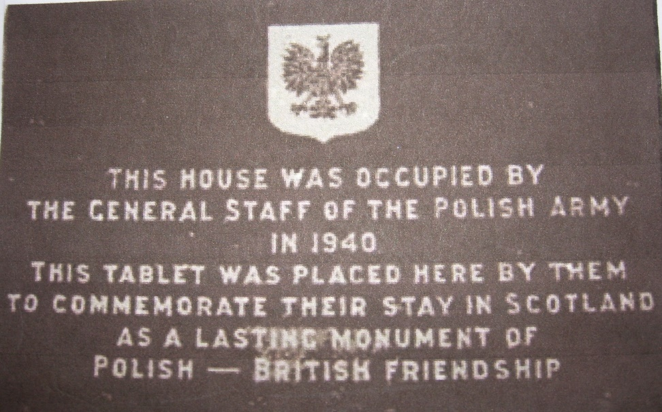
The 1st Rifle Brigade left Biggar by train in October1940 to take up their post at Cupar in Fife to defend the east coast of Scotland. On the 15th of October they held a farewell ceremony to thank the people of Biggar for their friendship and hospitality. Before they left they put up marble plaques on thebuildings they had used during their stay. The plaque from East End House at Carmichael is housed in the Visitors’ Centre, Carmichael Estate. The plaque on Carmichael House and the one on Biggar Primary School are now lost.
A Polish soldier’s poetic tribute to his adopted family in Biggar:
‘We were in many countries and ate the bread of many nations in our exile. The bread in a foreign land when you are in exile does not taste sweet. Your bread was the best, for it was given willingly and with a kind heart, not as a pittance, but like a loaf shared with a brother and a friend. You did not know us and yet you treated us like brothers’
Date: 30th Jun 2026 Back to Blog